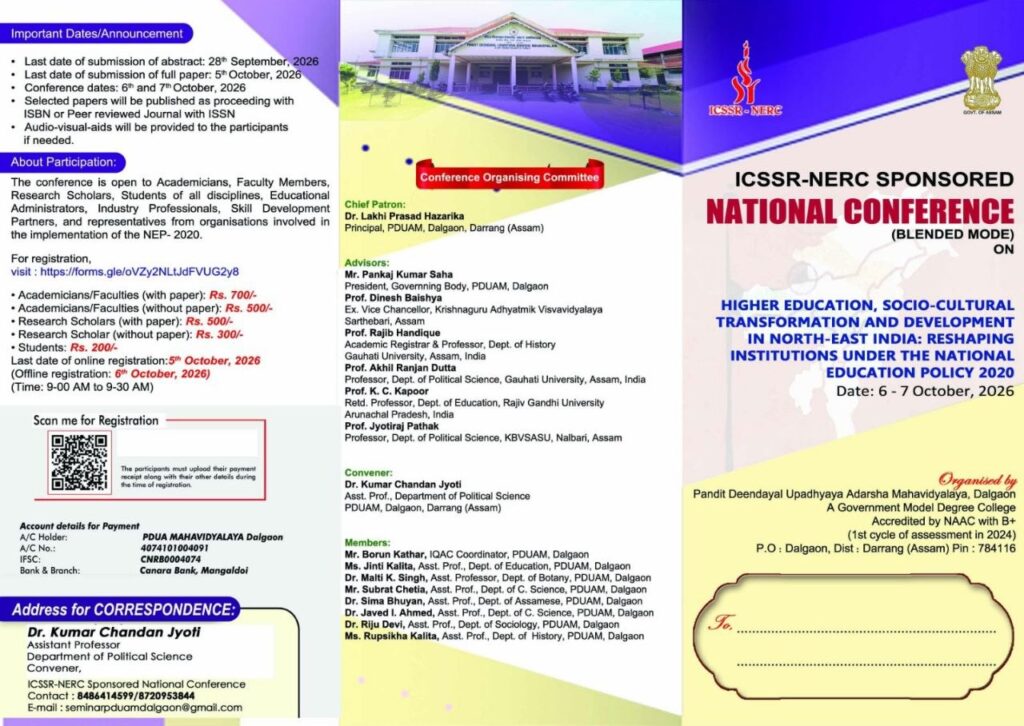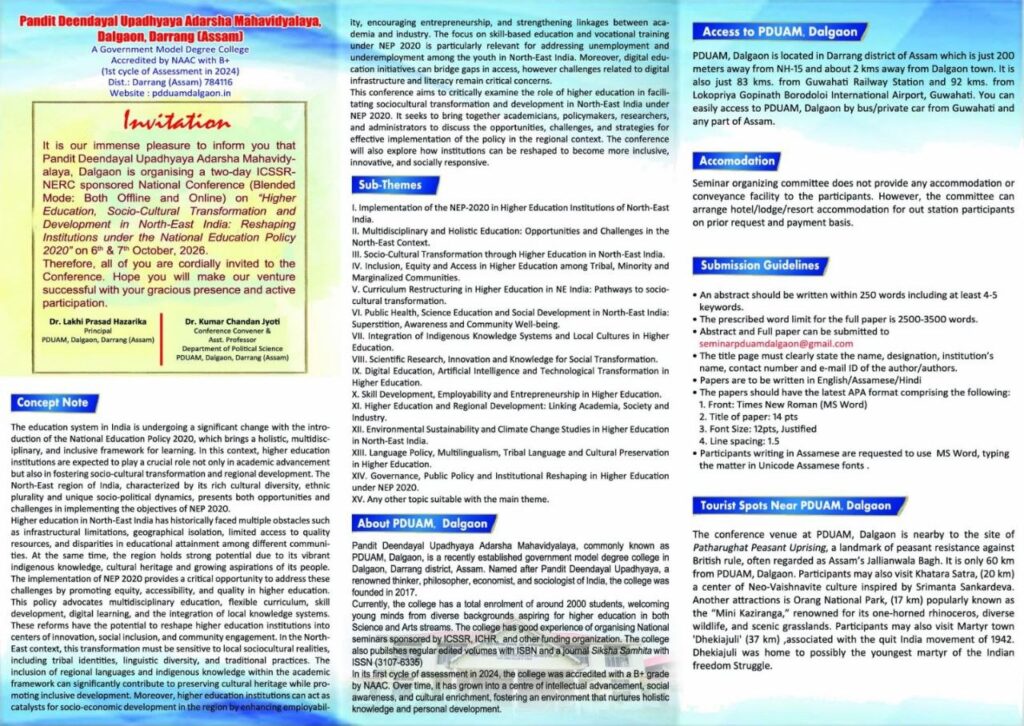
It is our immense pleasure to inform you that Pandit Deendayal Upadhyaya Adarsha Mahavidyalaya, Dalgaon is organising a two-day ICSSR-NERC, sponsored National Conference (Blended Mode: Both Offline and Online) on “”Higher Education, Socio-Cultural Transformation and Development in North-East India: Reshaping Institutions under the National Education Policy 2020” on 6th & 7th October, 2026. Therefore, all of you are cordially invited to the Conference. Hope you will make our venture successful with your gracious presence and active participation.
Link for Registration : https://forms.gle/oVZy2NLtJdFVUG2y8
Concept Note :
he education system in India is undergoing a significant change with the introduction of the National Education Policy 2020, which brings a holistic, multidisciplinary, and inclusive framework for learning. In this context, higher education institutions are expected to play a crucial role not only in academic advancement but also in fostering socio-cultural transformation and regional development. The oftl-East egion or ala, efaracterized By its fie eitra diversity, etnnie plurality and unique socio-political dynamics, presents both opportunities and challenges in implementing the objectives of NEP 2020. Higher education in North-East India has historically faced multiple obstacles such as infrastructural limitations, geographical isolation, limited access to quality resources, and disparities in educational attainment among different communities. At the same time, the region holds strong potential due to its vibrant Indigenous khowledge, cultural heritage and growing aspirations of its people.
The implementation of NEP 2020 provides a critical opportunity to address these challenges by promoting equity, accessibility, and quality in higher education. This policy advocates multidisciplinary education, flexible curriculum, skill
development, digital learning, and the integration of local knowledge systems. These reforms have the potential to reshape higher education institutions into centers of innovation, social inclusion, and community engagement. In the North ast context, this transformation must be sensitive to local sociocultural realities, including tribal identities, linguistic diversity, and traditional practices. The inclusion of regional languages and indigenous knowledge within the academic framework can significantly contribute to preserving cultural heritage while promoting inclusive development. Moreover, higher education institutions can act as catalysts for socio-economic development in the region by enhancing employabilty, encouraging entrepreneurship, and strengthening linkages between academia and industry. The focus on skill-based education and vocational training under NEP 2020 is particularly relevant for addressing unemployment and
underemployment among the youth in North-East India. Moreover, digital education initiatives can bridge gaps in access, however challenges related to digital infrastructure and literacy remains critical concerns.
This conference aims to critically examine the role of higher education in facili- tating sociocultural transformation and development in North-East India under NEP 2020. It seeks to bring together academicians, policymakers, researchers, and administrators to discuss the opportunities, challenges, and strategies for effective implementation of the policy in the regional context. The conference will also explore how institutions can be reshaped to become more inclusive, innovativre and socially responsive.
Sub Themes :
1. Implementation of the NEP-2020 in Higher Education Institutions of North-East India.
2. Multidisciplinary and Holistic Education: Opportunities and Challenges in the North East Context
3. Socio-Cultural Transformation through Higher Education in North-East India.
4. Inclusion, Equity and Access in Higher Education among Tribal, Minority and Marginalized Communities.
5. Curriculum Restructuring in Higher Education in NE India: Pathways to sociocultural transformation.
6. Public Health, Science Education and Social Development in North-East India: superstition, Awareness and Community well-being
7. Integration of Indigenous Knowledge Systems and Local Cultures in Higher Education
8. Scientific Research, Innovation and Knowledge for Social Transformation.
9. Digital Education, Artificial Intelligence and Technological Transformation in Higher Education.
10. Skill Development, Employability and Entrepreneurship in Higher Education.
11. Higher Education and Regional Development: Linking Academia, Society and Industry.
12. Environmental Sustainability and Climate Change Studies in Higher Education in North-East India.
13. Language Policy, Multilingualism, Tribal Language and Cultural Preservation in Higher Education.
14. Governance, Public Policy and Institutional Reshaping in Higher Education under NEP 2020.
15. Any other topic suitable with the main theme.
Submission Guideline :
An abstract should be written within 250 words including at least 4-5 keywords. The prescribed word limit for the full paper is 2500-3500 words. Abstract and Full paper can be submitted to seminarpduamdalgaon@gmail.com
The title page must clearly state the name, designation, institution’s name, contact number and e-mail ID of the author/authors
• Papers are to be written in English/Assamese/Hindi
The papers should have the latest APA format comprising the following:
1. Front: Times New Roman (MS Word)
2. Title of paper: 14 pts
3. Font Size: 12pts, Justified
4. Line spacing: 1.5
Participants writing in Assamese are requested to use Ramdhenu software Geetanjali fonts Page Maker File.
• A hard copy of research paper should be submitted to the Organising committee during registration.